Growth and Biodeterioration
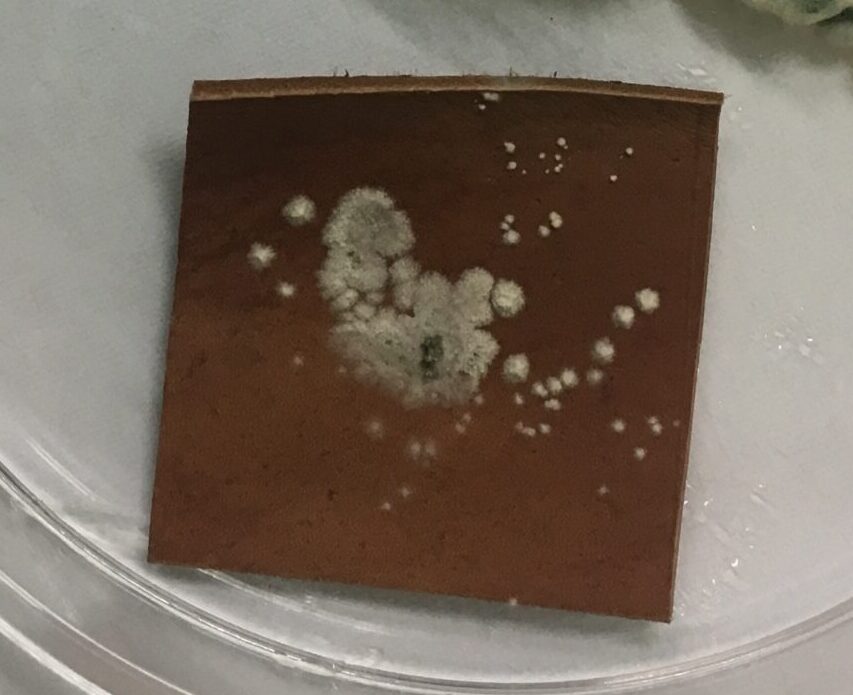
Fig. 4 – Mold growing on leather sample. Photo: Morena Ferreira
Part I introduced the fundamentals of mold in cultural heritage collections: what it is, why it grows, and why prevention matters. Part II goes deeper on the science behind two questions: what determines whether mold will grow in a given environment, and what is the impact on collections when it does?
First we will cover the biology of growth, and then discuss how mold causes damage. These concepts will help you understand the rationale behind the prevention and response strategies described in Part III.
1) What Enables Mold to Grow?
The two most important factors in enabling mold growth are the indoor environmental conditions and the presence of mold spores. Mold spores are pervasive. They will always enter buildings and land on surfaces; as a result, they cannot be eliminated from collection spaces. What we can influence is the environment that determines whether those spores remain dormant or germinate and grow. That is the focus of this section.
2) The Life Cycle of Mold
Despite their enormous variety, filamentous fungi share a common life cycle of four stages: hyphal growth, spore production, spore dispersal, and spore germination – from which new hyphal growth begins and the cycle repeats.
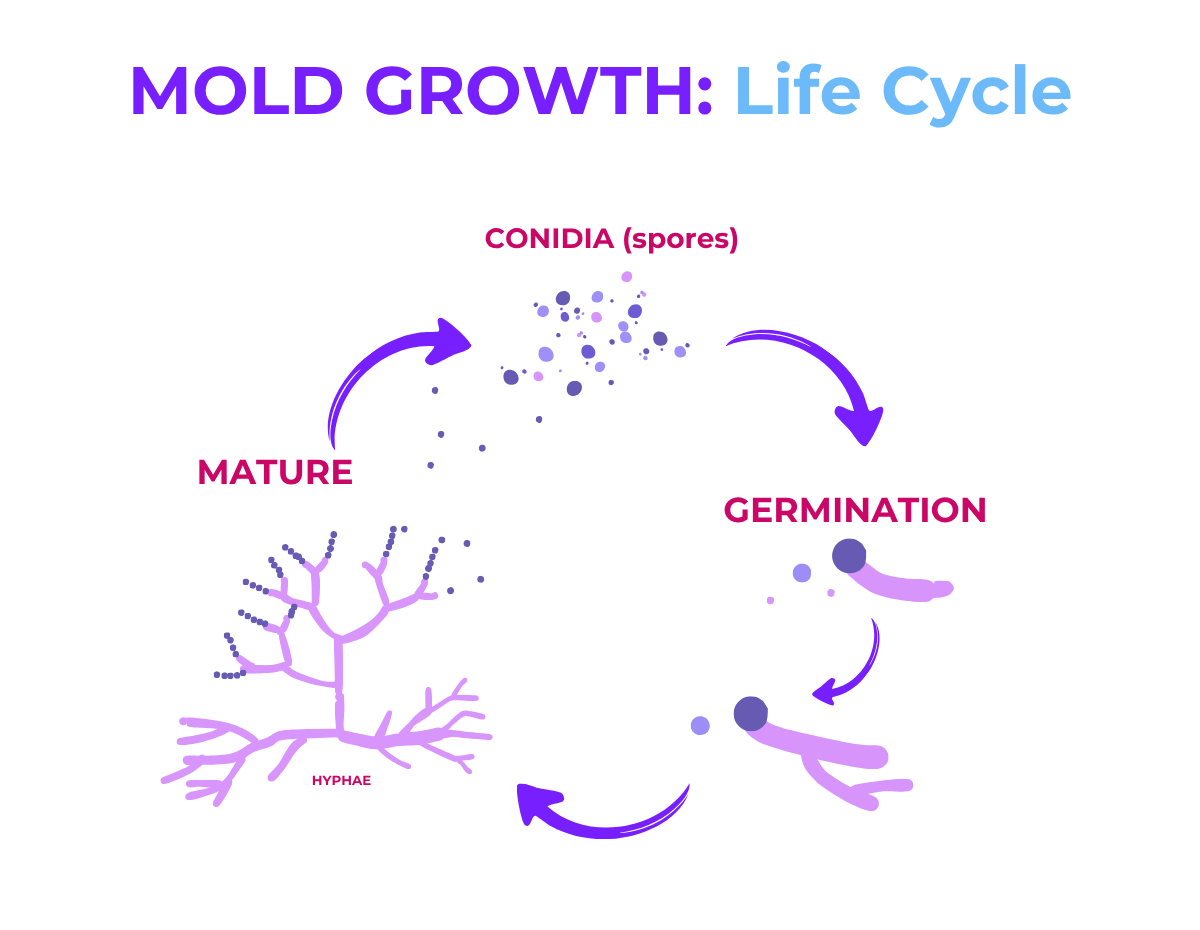
Fig. 5 – Life cycle showing the stages of mold growth
Hyphal growth is also referred to as vegetative growth, which starts with germination and occurs on and into the structure of materials. Spore production occurs with aerial growth, when hyphae grow away from the surface to produce reproductive propagules (spores) that eventually become airborne to colonise new materials.
Spores are produced with the aim of reaching other substrates with better survival conditions. Once a spore germinates, a hyphae emerges and continues to grow, branching along the way, to form a new colony whenever conditions are suitable. Hyphae grow only at their tips; this is called apical growth. As a colony expands, its center ages and no longer grows actively. In these central areas, spores are produced as a survival technique, to ensure new colonies will be produced.
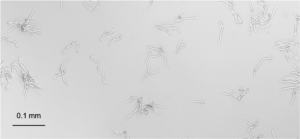
Fig. 5 – Aspergillus versicolor hyphae growing after 20h (at ideal conditions: 27 °C and 98% RH). The average hyphal length is 0.06 mm. Magnification 100X. Photo: Morena Ferreira.
3) How Mold Grows
Mold greatly depends on the presence of water to survive and thrive, specifically water available at the surface of a material and in the air immediately adjacent to it, which is referred to as water activity (aw) or equilibrium relative humidity (ERH). This is water that has weak bonds to molecules in materials and that changes with temperature and RH. Each mold has ideal water activity and temperature at which germination and growth occurs at their highest rate. But mold does not depend on ideal water activity and temperature simultaneously to develop. When temperatures are close to optimal, these microorganisms can tolerate water activities that are either higher or lower than ideal. The reverse is also true: suboptimal temperatures can sustain growth if water activity is close to optimal level for that species. In such circumstances development will be slower compared to ideal conditions. The relationship between germination and growth rate, water activity, and temperature, is graphically described by isopleths – lines of equal germination or growth rate specific to each species. (1) For example, Aspergillus versicolor, a very common mold species, has an ideal growth temperature of 27 °C but can grow between 9 °C and 39 °C depending on the water activity. For collections care, this means that controlling temperature is often insufficient to guard against mold, as the mold can adapt as long as moisture is present. Given that heritage materials provide significant nutrients, this ability to grow at suboptimal environmental conditions increases the risk of mold growth indoors and is a big challenge for prevention.
Water plays additional roles beyond enabling germination. Together with nutrients, mold absorbs water through its cell walls to maintain the high level of water content (approximately 85%) its living cells require. Mold also uses water in the processes of external digestion and absorption of nutrients.
________________________________
(1) An example of isopleths for the growth rate for different molds can be found in fig.5 of “Prediction of mould fungus formation on the surface of and inside building components” by Klaus Sedlbauer (2001), available here.
Notably, mold is able to retain water not only inside its cells but also around its hyphae, creating a microclimate that supports continued growth even when the broader conditions become too dry. This self-sustaining quality makes mold more resilient to changes in its environment.
When conditions become unfavorable for mold, it becomes dormant, but it does not die. Germination, hyphal growth, reproduction, and production of spores all come to a halt (or close to it), but the organism remains viable and will resume metabolic activity and growth once conditions become suitable. From a practical standpoint, this means that addressing a mold outbreak without also correcting the underlying environmental conditions is unlikely to be a lasting solution.
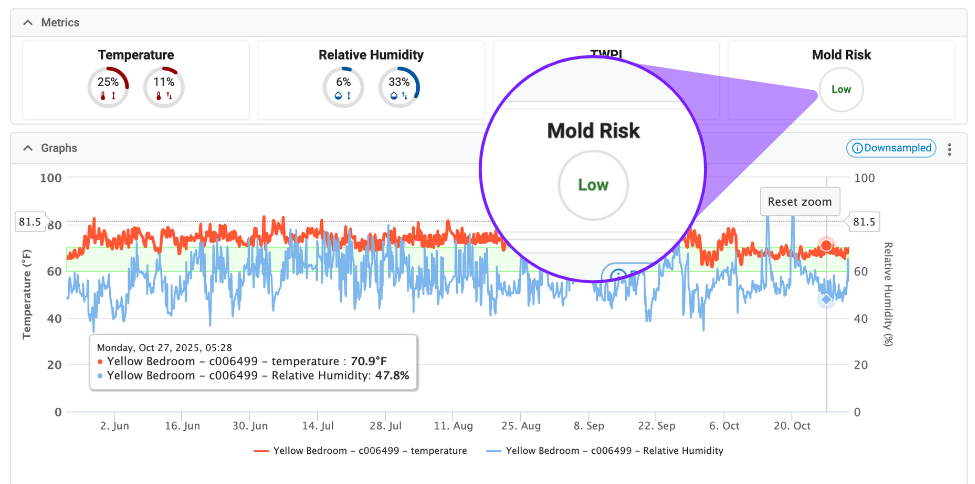
Conserv Cloud Pro includes a Mold Risk Score indicator. The software reviews the data and automatically evaluates mold risk based on research completed at the Image Permanence Institute. Read more here.
4) Types of Mold
Mold species are incredibly varied – it is estimated that 2.2 to 3.8 million species exist, of which approximately 8% have been identified.
In the UK and the US, some of the most common species present in historic houses and museums belong to the genera (2) Aspergillus, Penicillium, Alternaria and Cladosporium. These are the same groups of fungi generally found indoors in these countries. However, the distribution of species varies with geography and climate, as well as across seasons and weather conditions.
Another factor that will dictate the microorganisms found growing on a surface is the type of materials present. In archives, we will mostly find mold that is able to digest cellulose substrates. In other collections, species capable of breaking down protein-based materials, such as animal glues or gelatin on photographs, may be more prevalent.
5) How Mold Causes Damage
As discussed in Part I, mold is a health hazard, in addition to being a threat to collections. The first signs of biodeterioration caused by mold are often visual and can be accompanied by a moldy or musty smell.
Mold growth results in both chemical and physical damage to materials. The secretion of metabolic enzymes and acids causes pigmentation and a weakening of materials as they are broken down, ingested, and lose structure. Physical damage is also caused by growing hyphae: they grow not only along a surface, but also enter materials, developing under the surface.
________________________________
(2) Genera are categories of organisms with shared characteristics. Each genera contains several species.
6) How Mold Feeds
As mold expands its hyphae and colonies, it feeds on the compounds that form the substrate. Its method of acquiring nutrients is distinct from other organisms: while plants and animals ingest food and digest it internally, mold digests materials externally. Digestive enzymes are produced along the length of the hyphae, in greatest concentration at the growing tips. This external system exists because many compounds, such as cellulose, lignin, and proteins, are unavailable to mold because they are either insoluble or too big to enter the walls of fungal cells. They must first be broken into smaller, simpler molecules that can be easily absorbed.


Fig. 6 – Mold white spots on black and white photograph. The mold growth is particularly visible on the hair area. Photo: Argentina, Instituto Nacional de Estudios de Teatro, Sección Documentos Visuales. Ana Masiello.
7) Mold’s Effects on Different Types of Materials
Mold grows on most materials, and feeds mostly on organic compounds.
Different mold species specialize in deteriorating and digesting certain compounds, dictated by the type of digestive enzymes they produce. For example, species that produce cellulase are able to break down cellulose (present in paper, textiles, wood), such as many Aspergillus and Penicillium species which are commonly found indoors. But these microorganisms produce a range of enzymes enabling them to grow on materials with complex compositions and to not depend on very specific molecules. One species might simultaneously produce enzymes to digest cellulose, starches, and proteins, for example.
Acids produced by mold to aid digestion can also deteriorate inorganic materials. Molds can survive on the surfaces of inorganic material, where organic matter – such as the dust that settles on most surfaces – provides a food source. This reinforces the importance of regular surface cleaning as discussed in Part I: removing dust minimizes this organic food source.
Deteriorated or aged materials may also be more vulnerable to mold growth, as aged materials are more fragile and can therefore be easier to decompose.
About the Author
 Dr. Morena Ferreira is a conservator specializing in preventive conservation, with particular expertise in the prevention of mold development in heritage materials and environmental control in museum contexts. She teaches risk management in cultural heritage at the Escola Superior de Conservació i Restauració de Béns Culturals de Catalunya in Barcelona, Spain. Prior to completing her PhD in Heritage Science at UCL (London) in 2023, Morena worked in the conservation of wall paintings, stone, and easel paintings in Portugal, Brazil, and the UK.