A failing HVAC component rarely announces itself. In this guide, Christopher Cameron, Conserv’s Director of Conserv Services, explains what the loss of a coil, humidifier, fan, or sensor actually does to a collection space — and why the answer changes with the season and with how your unit is built.
Knowing what happens when a component fails helps you recognise a developing problem before it reaches your collection. But knowing what a component does is only half the story. The effect of a failure often depends on the season, and on how the unit itself is put together.
If you aren’t yet familiar with the parts of an air handling unit, start with Inside an HVAC System, which walks through each component in turn.
What failure looks like, by season
The heating coil, cooling coil, and humidifier each behave differently depending on the time of year. The same failure can be a non-issue in one season and a real risk in another.
Heating or reheat coil
- Warm and humid months — watch closely. Air reaching the space may be cold and more humid than intended. Near a supply vent, that combination can cause condensation on nearby objects, which is a mold risk.
- Cool and dry months — moderate effect. Spaces get colder. This is usually reported first as a human comfort complaint rather than a collection concern.
Cooling coil
- Warm and humid months — watch closely. Spaces tend to warm up, since the system can no longer remove heat. Dehumidification capacity also drops, so watch for a rising dew point.
- Cool and dry months — minimal effect. Often has little to no impact on the spaces this unit serves.
Humidifier
- Warm and humid months — moderate effect. Little noticeable change in humid climates. In hot, dry regions, or during the dry winter months, RH will likely start to drift downward without it.
- Cool and dry months — watch closely. This is when the loss is felt most. RH drops, and can fall below safe levels for the collection.
Two components without a seasonal pattern
- Fan motor — powers and spins the fan that pushes air through the system. In a multi-fan system, losing one motor typically reduces airflow. In a single-fan system, the unit is likely to shut down entirely, since it has no other way to move air.
- Sensor — sensors throughout the unit monitor fan speed, temperature, and humidity, and feed that data to the components they control. Losing a sensor can mean the component it feeds loses control entirely: a heating coil whose sensor fails may stay locked on or off, depending on how it has been programmed. These are the system’s own control and monitoring sensors, which are separate from your Conserv sensors.
Why component order matters
The order in which the cooling and heating coils appear in an air handling unit determines what the system can do — and what you lose when a coil fails. Three layouts are common.
Cooling and reheating unit
The unit cools air at the cooling coil, often dehumidifying it in the process, then reheats it to the target setpoint at the heating coil. The cooling coil sits ahead of the heating coil, followed by the humidifier and supply fan. This layout gives the system real dehumidification capability.
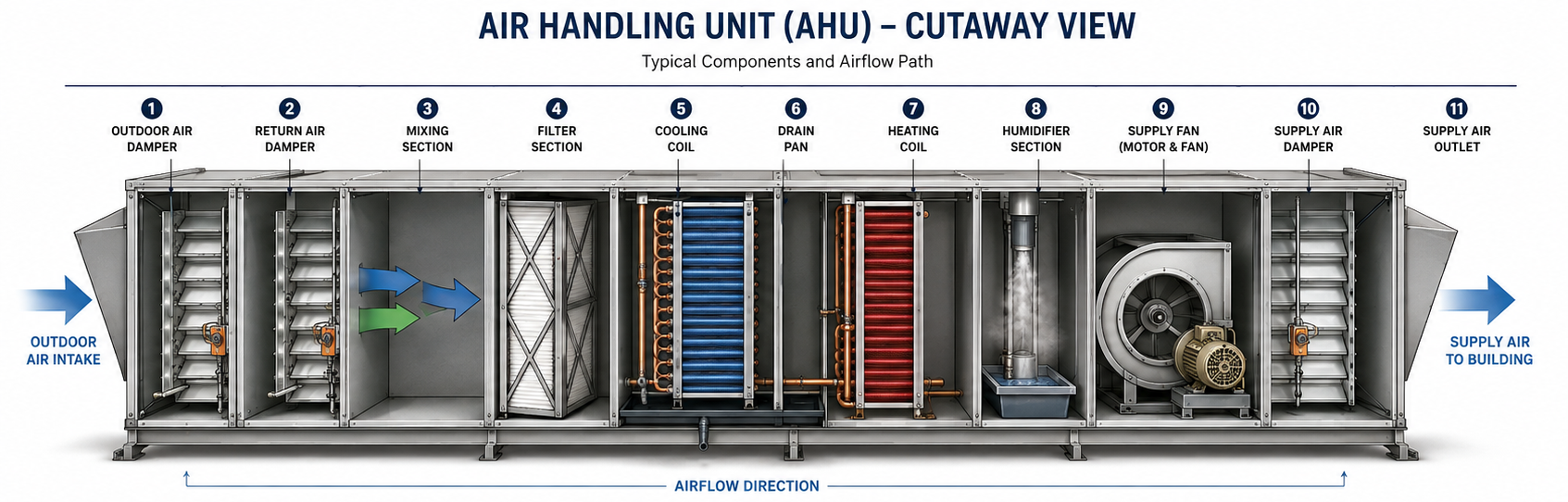
- Loss of the cooling coil — no cooling and no dehumidification.
- Loss of the heating coil — no heating. Air leaving the unit can be low-temperature and high-RH, creating potential for condensation and mold.
Heating-or-cooling unit
Here the heating coil comes first and the cooling coil second, so air passes through one or the other rather than both. The system can only heat or cool at a given time. This layout is built for minor temperature adjustments and offers little real dehumidification.
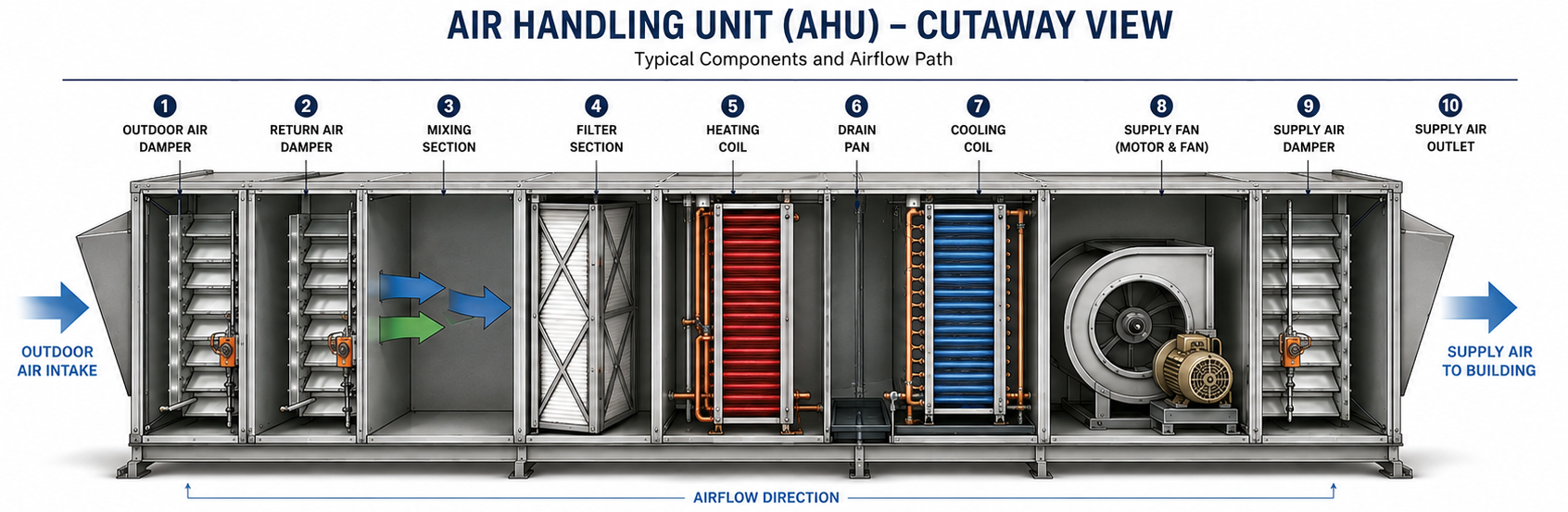
- Loss of the cooling coil — no cooling.
- Loss of the heating coil — no heating.
Downstream reheat
The main unit holds only a cooling coil, which cools and potentially dehumidifies the air. That cold air is then distributed to individual reheat coils near each zone, which bring it up to temperature locally.
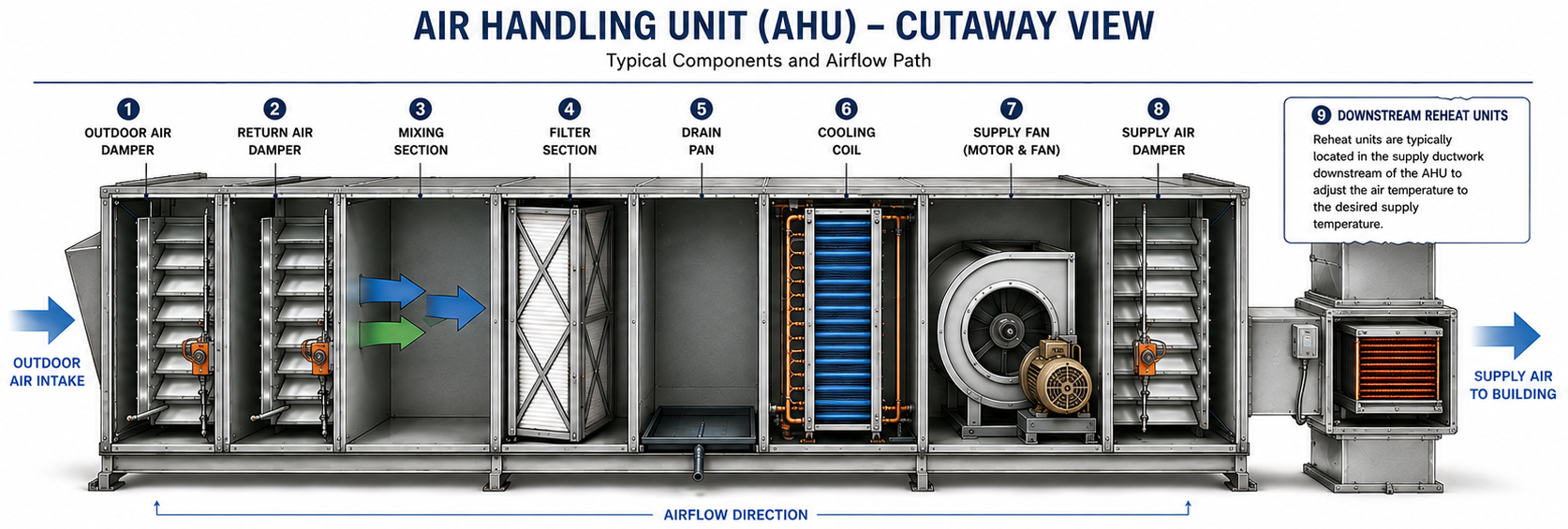
- Loss of the cooling coil — no cooling and no dehumidification for the whole system and every zone downstream.
- Loss of a heating coil — no heating for that specific zone. Low-temperature, high-RH air can cause condensation and mold there.
Quick reference
- Subcool reheat. Loss of cooling coil: no cooling and no dehumidification. Loss of heating coil: no heating, and low-temperature, high-RH air is possible.
- Heating-or-cooling unit. Loss of cooling coil: no cooling. Loss of heating coil: no heating.
- Downstream reheat. Loss of cooling coil: no cooling and no dehumidification for the whole unit. Loss of heating coil: no heating for that zone, and low-temperature, high-RH air is possible there.
If something has already failed
Recognising the failure is the first step. What to do next depends on how long the repair will take: see our short-term HVAC failure response guide for the first hours, and the long-term failure guide for outages running beyond 24 to 48 hours.
The printable version of this guide, along with our full set of HVAC and facilities reference guides, is available in the Conserv resource library.
TALK TO AN EXPERT
Questions about your own system or your data?
Chris Cameron, our Director of Conserv Services, works with museums, libraries and archives on mechanical systems, environmental data and energy efficiency. A short call costs nothing and usually saves a lot of guesswork.
Or browse the printable guides in the Conserv resource library.