HVAC is the single biggest lever you have over your collection environment — and for most collections staff, the least visible. In this guide, Christopher Cameron, Conserv’s Director of Conserv Services, opens up an air handling unit and walks through what each part does, and why it matters for the objects in your care.
HVAC stands for Heating, Ventilation, and Air Conditioning — the collection of equipment that controls the temperature, relative humidity, and purity of the air in a space. In a collections environment, this system is doing more than keeping people comfortable: it is the primary tool for slowing deterioration, deterring mold, and preventing damaging swings in the environment around your objects.
The path air takes through the system
Air moves through an air handling unit (AHU) in a fixed sequence. Each section does one job to bring outdoor and return air to the temperature and humidity your collection needs.
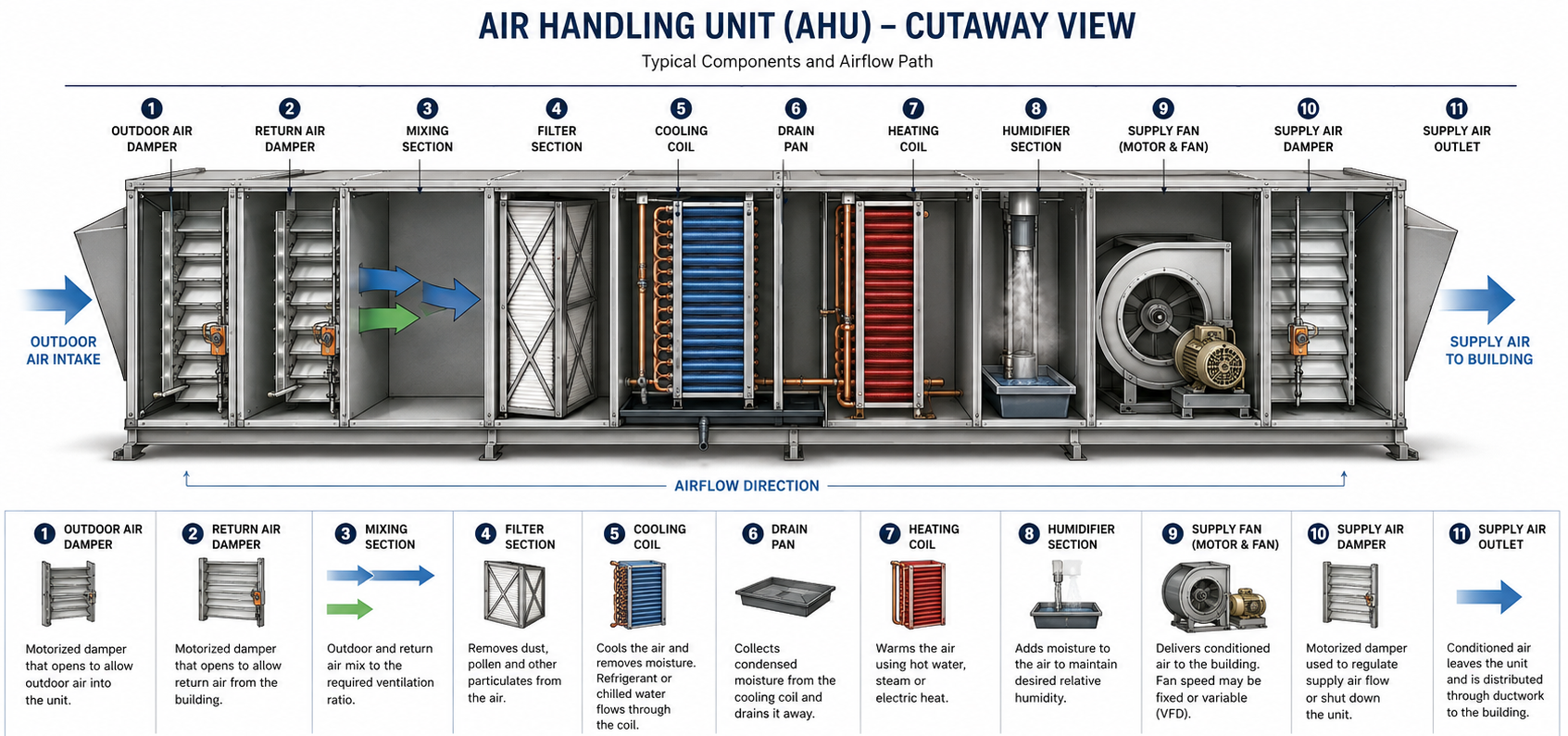
- Outdoor air damper — motorised damper that opens to allow outdoor air into the unit.
- Return air damper — motorised damper that opens to allow return air from the building.
- Mixing section — outdoor and return air mix to the required ventilation ratio.
- Filter section — removes dust, pollen, and other particulates from the air.
- Cooling coil — cools the air and removes moisture. Refrigerant or chilled water flows through the coil.
- Drain pan — collects condensed moisture from the cooling coil and drains it away.
- Heating coil — warms the air using hot water, steam, or electric heat.
- Humidifier section — adds moisture to the air to maintain the desired relative humidity.
- Supply fan (motor and fan) — delivers conditioned air to the building. Fan speed may be fixed or variable (VFD).
- Supply air damper — motorised damper used to regulate supply air flow or shut down the unit.
- Supply air outlet — conditioned air leaves the unit and is distributed through ductwork to the building.
Three numbers worth knowing
- Temperature — how hot or cold the air is. Relatively easy to control, and a major driver of energy use.
- Relative humidity — how much water vapour the air holds, as a percentage of what it could hold at that temperature. Harder and more energy-intensive to control than temperature.
- Dew point — the temperature at which moisture in the air begins to condense. Often the clearest way to understand real moisture risk, mold, and condensation in a space.
Sensors and controls
- Thermostat — reads temperature and tells the system when to heat or cool.
- Humidistat — reads relative humidity and signals when to add or remove moisture.
- Building Management System (BMS) — the computer that reads every sensor and automatically operates the dampers, coils, humidifier, and fans to hit the setpoints your collection needs.
Some BMS platforms can also trend data over time. That is useful as an extra monitoring point, or to compare what the system thinks is happening against what a separate data logger actually records.
Other components you may see
Larger or more complex systems add pieces to fine-tune airflow, humidity, and energy use:
- VAV boxes (variable air volume) — adjust how much conditioned air reaches a specific zone or room.
- VFDs (variable frequency drives) — let motors run fans and pumps at variable speeds instead of full-on or full-off, saving energy.
- Cooling towers — reject heat from the system’s cooling water to the outside air.
- Desiccant systems — use a moisture-absorbing wheel or material to dehumidify air without a cooling coil.
- Turning vanes — guide airflow smoothly around sharp turns in ductwork, reducing turbulence and noise.
Why this matters for your collection
- Mold risk — when surface temperatures drop near the air’s dew point, moisture condenses. This is a leading trigger for mold growth on objects and walls.
- Organic materials — swings in temperature and RH cause organic materials to expand and contract, leading to cracking, warping, and flaking over time.
- Metal corrosion — sustained high humidity accelerates corrosion on metal objects, fasteners, and mechanical parts alike.
- Humidity-sensitive inorganic materials — most inorganic materials are affected only by extreme conditions, but some metals, minerals, and glass are vulnerable in damp or even mid-range conditions.
- Energy cost — HVAC typically accounts for about 30% of a commercial building’s energy use, more than any other single system.
Where to go next
Knowing what each component does is the groundwork. The next question is what happens when one of them stops working — which depends on both the season and how your particular unit is built. That’s covered in When a Component Fails.
This guide is adapted from Conserv’s HVAC Systems training presentation. The printable version, along with our full set of HVAC and facilities reference guides, is available in the Conserv resource library.
TALK TO AN EXPERT
Questions about your own system or your data?
Chris Cameron, our Director of Conserv Services, works with museums, libraries and archives on mechanical systems, environmental data and energy efficiency. A short call costs nothing and usually saves a lot of guesswork.
Or browse the printable guides in the Conserv resource library.